
Project Updates
Fire on the Ridge: The ‘Inimim Pile Burn
After weeks of waiting for a weather window, a crew from Terra Fuego Resource Foundation, the BLM, and Yuba Watershed Institute put fire on roughly 250 acres of machine piles in the ‘Inimim Forest over two long days in spring.
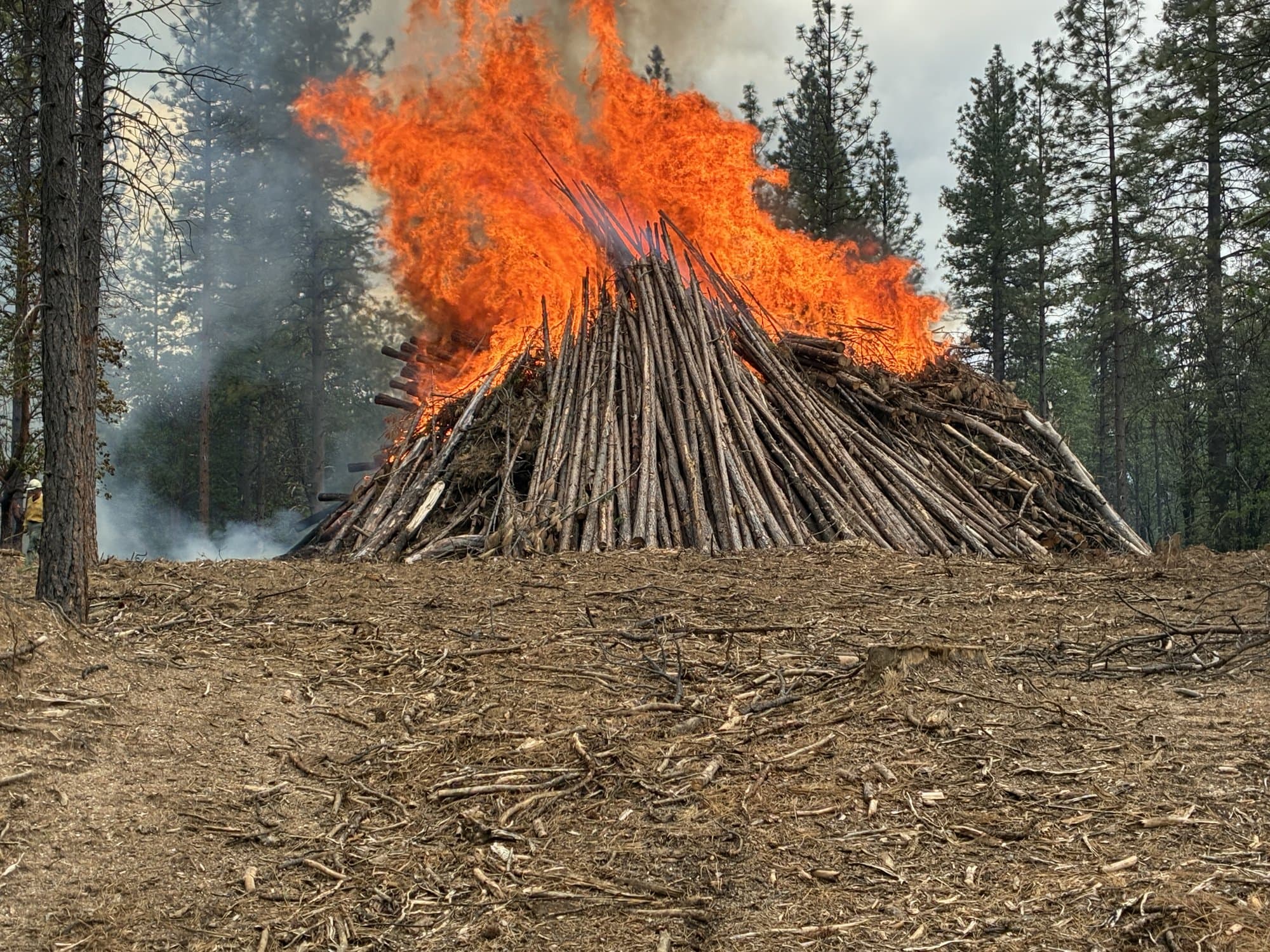
Waiting for the window
Prescribed fire is mostly waiting. It's checking the forecast, checking it again, watching the fuel moisture numbers tick up and down, and being ready to go — or not go — at short notice.
The ‘Inimim pile burn was first floated for a window between March 11 and March 22, with March 16 as the tentative primary day. That window closed without firing a single pile. "Just wanted to clarify with everyone we will NOT be burning on Monday 3/16," Jorge Pacheco of the U.S. Wildland Fire Service wrote on March 13. "Duane and I will continue to monitor for a good burn window and will notify you all when we settle on a date."
The next target was Tuesday, March 31 at 0800, with a plan to meet at the intersection of Shady Grove and Jackass Flats Road. The forecast — mostly cloudy, rain likely in the morning, rain likely in the afternoon, a max temperature around 60°F, humidity in the high 60s, and light south winds — put every prescription parameter comfortably in the "cool" end of the acceptable range. A wet day is a good day for pile burning. The crew committed.
The work itself had been years in the making. The ‘Inimim Forest — roughly 2,000 acres of BLM-managed public land interwoven with private parcels along the San Juan Ridge — has been the subject of a long, active restoration partnership between the BLM Mother Lode Field Office and Yuba Watershed Institute. The machine piles scheduled for ignition had been built over the past few months as part of Phase 3 of the ongoing ‘Inimim Forest Restoration Project, an SNC-funded effort to thin overstocked stands, reduce the hazardous fuel load, and return the forest to a more fire-resilient condition. Thinning without burning only gets you halfway there; the piles had to come down.
Putting fire on the ground
By late morning, a dozen firefighters in yellow Nomex were lined up along the shoulder of Jackass Flats Road getting their briefing from Terra Fuego Resource Foundation burn boss Duane Fields. Behind them, a water tender, an engine, a command trailer, and a skid steer staged for the day's work. Hose packs, portable pumps, and drip torches came off the truck and headed into the burn units.
The first piles went up fast. Machine piles built from a whole season of thinning slash are mostly dry-cured stems and limbs, packed tight, and once ignition occurs the whole pile is typically involved very quickly. Flame lengths pushed 30 feet; heard from the road, the sound was a steady low roar with the occasional crack of something structural giving way inside.
The BLM's public notice had gone out a few weeks earlier, and we'd spread the word to the Jackass Flats community directly through neighbor Sara Greensfelder's email list. The response was warmer than you might expect for a day of smoke on the ridge.
“First day of burning at ‘Inimim went really well! 200 Acres accomplished today, the plan is to return tomorrow to finish the rest. Lots of public support, several of the neighbors drove by, took pictures, and expressed gratitude.”
— Jorge Pacheco, U.S. Wildland Fire Service, 7:57 PM, March 31
By the time the light faded, roughly 200 acres worth of piles had been lit, watched down to a safe state, and handed off to a Type 6 engine that would patrol the burn area through the night. "No holding concerns," the engine crew reported on the radio. More rain was in the forecast for the morning.
Finishing the job
The crew met back on Jackass Flats at 9:00 AM and spent Day 2 working through the remaining piles, scattered across the ridge between Silverthorne Lane and North Canyon Road. A light, steady rain kept atmospheric conditions cool all day; the skid steer worked the margins of slower-burning piles, pushing unconsumed logs back into the coals to keep them burning hot.
By late afternoon, the targeted acreage was complete.
“Another great day of burning. We completed our targeted acres. Total approx. acres are 250–260. I would say we reached our goal of reducing the biomass by at least 85%. Most of the material left appears to be nearing or in the 8+ inch diameter / 10,000 hour fuel size.”
— Jorge Pacheco, 8:34 PM, April 1
Mop-up, patrol, and out
Two days of active ignition is only the beginning. What follows is the quiet, unglamorous part of prescribed fire: mop-up — systematically working every pile with water and hand tools to extinguish hot spots, remove residual heat, and make sure nothing re-ignites after the crew leaves.
Terra Fuego's Jason Davis took over as the weekend point of contact, patrolling the burn area for smoke and heat. On April 3, Jorge confirmed mop-up was complete. The next six days were quiet patrols.
“Inimim Pile Burn is Out. With no smoke and no heat reported for three consecutive days, the last patrol from Terra Fuego pulled off this afternoon. Porterville Dispatch has been notified. Thank you, hope to see you on the next!”
— Jorge Pacheco, 1:18 PM, Thursday, April 9
Through the lens
Photographer Hilary Hattie Waters of Yahïla Foto joined the crew on Day 1 and captured the scale, heat, and human side of the burn. Her images are used here with permission.
All photos in this gallery © Hilary Hattie Waters / Yahïla Foto. Used with permission.
What it accomplished — and what's next
Across two days, the ‘Inimim pile burn put fire on roughly 250–260 acres and consumed at least 85% of the machine-piled biomass built up from Phase 3 thinning. The material that remains is almost entirely in the 8-inch-plus, 10,000-hour fuel category — big-diameter logs that are difficult to consume in a single burn and will continue to decompose naturally on the forest floor.
A week after the burn, Duane Fields walked the units with supervising forester Katherine Benedict (TÜV SÜD America) and identified four piles — one in each unit — that didn't burn down as thoroughly as hoped. Rather than force those piles now, Terra Fuego proposed returning in the fall of 2026 to consolidate and re-burn them. A portion of the contract value is being held back until that cleanup is complete.
Pile burning is one piece of a bigger restoration arc in the ‘Inimim Forest. With the 2026 piles on the ground, attention turns toward the remaining Phase 3 implementation work, continued monitoring of the treated stands, and — eventually — reintroducing broadcast prescribed fire under conditions that mimic the low-intensity burns that shaped this forest for thousands of years.
Thanks to the crew
Prescribed fire is a team sport, and this one took more coordination than you can see in any single photo. Gratitude is owed to:
- Terra Fuego Resource Foundation — Bill Jacks, Duane Fields (burn boss), Jason Davis, and the full ignition and holding crew
- BLM Mother Lode Field Office and U.S. Wildland Fire Service — Jorge Pacheco, Burns Brimhall, David Brinsfield, Jeffrey Horn, Roger Brown, and Beth Brenneman
- TÜV SÜD America Forestry Consulting — Katherine Benedict (Registered Professional Forester) and Ben Miller
- Northern Sierra Air Quality Management District — for smoke coordination
- The Jackass Flats and North Columbia neighbors — who drove out to take pictures, waved as they passed, and made clear that this kind of work is welcome in this community
Funding for the Phase 3 work that built these piles comes from the Sierra Nevada Conservancy (Agreement #1507).
Want to see this work up close?
For more on the project this burn was part of, visit the ‘Inimim Forest Restoration Project page. To get notified about future public field tours, sign up for our newsletter at the bottom of any page.
More from YWI
Notices of Intent to Award: Round Mountain and South Yuba Rim Fuels Reduction
YWI intends to award the Round Mountain Phase 1 fuels reduction work to GP Development & Land Clearing LLC, and the South Yuba Rim Phase 2 work by Bid Item to First Rain Land Stewardship Services LLC, Wildland Corporation, and GP Development & Land Clearing LLC. Work is planned for November 2026 through February 2027.

Tree Rings #31 Wants Your Words and Art
The Yuba Watershed Institute's community journal is gathering essays, poems, drawings, photos, and wildlife sightings for issue #31, its first in five years. The theme: how you relate to the natural world around you. All ages welcome.

Free Forest Entrepreneurship Bootcamp Nov. 7–8 at Sierra College
Sierra Commons and the Sierra Business Council are hosting a tuition-free, two-day Forest Entrepreneurship Bootcamp on November 7–8 at Sierra College's Rocklin campus for people launching or growing forest and wildfire-resilience businesses. YWI Executive Director Chris Friedel will present as part of the class.